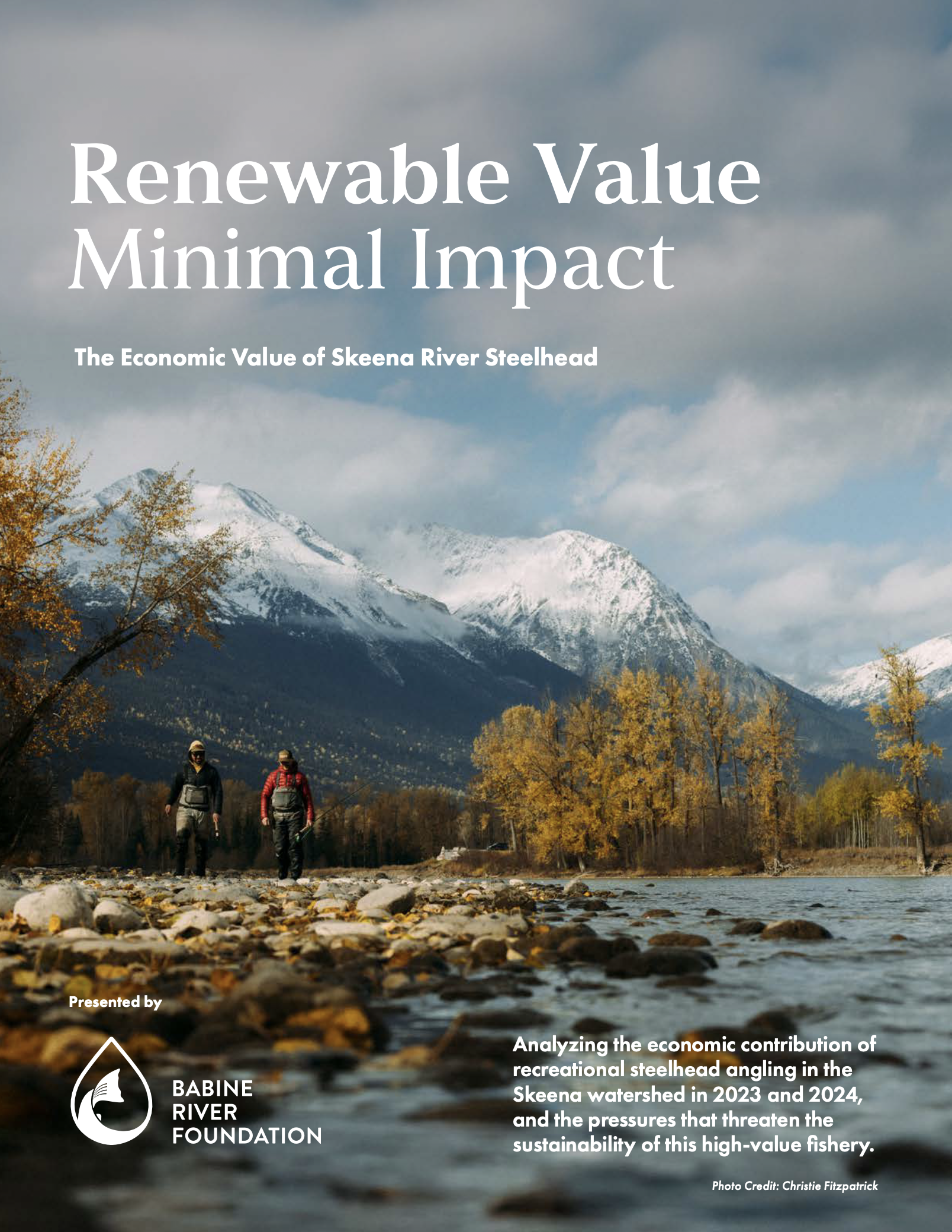
Photo: Christie Fitzpatrick
Skeena Steelhead Economic Report
Analyzing the economic contribution of Skeena Steelhead Angling
Click image to download the PDF Summary
The Upper Skeena Angling Guides Association is proud to share the results of the comprehensive Skeena Steelhead Economic Study. Conducted by Big River Analytics the study examines the economic importance of steelhead angling in the Skeena Watershed and explores how ocean-based factors—including commercial fisheries and pink salmon ranching—influence steelhead survival, angling activity, and tourism spending.
The Skeena Watershed is widely regarded as the mecca of steelhead angling in the Pacific Northwest, offering what many consider the world’s premier steelhead fishing experience. These iconic fish are deeply important to local communities, supporting businesses, jobs, tourism, and a globally recognized recreational fishery that attracts anglers from around the world.
The study found that steelhead angling in the Skeena watershed contributes significantly to both the regional and provincial economy. Across British Columbia, Skeena steelhead angling generates approximately:
$33 million in gross economic output
$16 million in GDP
$11 million in labour income
291 full-time equivalent jobs supported
Guided angling in the Upper Skeena watershed forms the economic backbone of the fishery, accounting for more than 60% of total economic contributions within the North Coast–Nechako region. The report also highlights the exceptional economic value tied to individual steelhead caught and released by guided anglers. On average, each fish is associated with approximately:
$3,500 in gross economic output
$1,900 in GDP
$1,300 in regional income
Every 27 steelhead caught and released supports one local full-time job. During low-abundance years such as 2023, guided angling in the Upper Skeena generated roughly $7,000 in gross output per steelhead caught.
Activities removing steelhead without generating comparable economic benefits may represent an opportunity cost exceeding $100,000 in provincial gross output per fish.